Wartime scarcity in Město
The Glass RoomWartime scarcity in Město strips daily life down to food, fuel, shelter, and the means to obtain them. As the front approaches, money loses its authority and barter becomes the city’s practical economy; Laník’s basement stores turn shortages into both a means of survival and a source of leverage. The privation also changes how the Landauer House is inhabited: a space first conceived as a light-filled modern home becomes, in successive periods, a Nazi research centre and a children’s physiotherapy gymnasium.
A City Reduced to Necessities
The war seems to stretch backward into memory and forward into an unknowable future. Město’s inhabitants subsist on potatoes, turnips, and beets, dug from the earth and described as tasting of it. Their existence is likened to that of a whole city of hunter-gatherers. German troops move east and disappear; what returns is the defeated and damaged, human wreckage cleared away to make room for more fighting. Scarcity is therefore not just an absence of goods: it is the visible condition of a city caught in the war’s continuing movement.
As liberation draws nearer, the streets become nearly empty except for the machinery of war. Residents emerge from cellars and basements to search for candles, potatoes, bread, paraffin for cooking, soap, matches, and cigarettes. The passage compares their subterranean existence to that of troglodytes and says that barter has carried the city back a thousand years. Money, once the ordinary measure of value, has become insignificant beside the things that can keep a household alive.
Laník’s Basement Economy
Laník makes scarcity legible as exchange. He knows instinctively how much bread a quantity of cigarettes will buy, or how much cake is worth a candle. His supplies include cigarettes, paraffin, powdered egg, and powdered milk, carefully kept in the maze-like basement rooms. Rather than describing this hoard as miserliness, the narrative compares it to a banker’s investment: provisions are stored against need and exchanged when other people have little choice.
People descend the outside steps to do business with him, bringing accounts of hardship and destitution. Laník listens sympathetically, extends credit when he judges it worthwhile, and accepts payment in kind. His generosity and calculation coexist. The arrangement is not represented as simple charity: he understands that antagonizing customers would be bad for business, while his stock makes him valuable to people facing immediate need. His insistence to his sister that they must take opportunities captures the practical, morally ambiguous logic of surviving through scarcity.
That logic becomes intimate when Jana Kubecová comes seeking powdered milk for her baby. Her husband was deported to work near Hamburg six months earlier, and she has received no news for two months; she fears that he may be dead. Laník calculates the exchange, takes her down into the basement, and adds a packet of cigarettes. His attention to her and her bleak, resigned smile place personal desire alongside the transaction, without erasing her precarious circumstances: she has left a sleeping infant at home and says she cannot stay long. In this economy, a small extra packet is at once a commodity and a gesture shaped by need.
The Approaching Front
Scarcity intensifies amid rumours and reports of military movement. At the pub U Dobrého Vojáka, workers from the armament factory gather to hear that the Red Army is coming. Novotný follows its advances as a personal triumph and displays a map in which the Soviet front seems to swell across Central Europe. The scale of the war is hard for the men to comprehend: place names and distances are vast, while news of armies, aircraft, civilians, and deaths arrives in fragments. The expectation of liberation does not make the present safer; it sharpens uncertainty about when the fighting will reach the city.
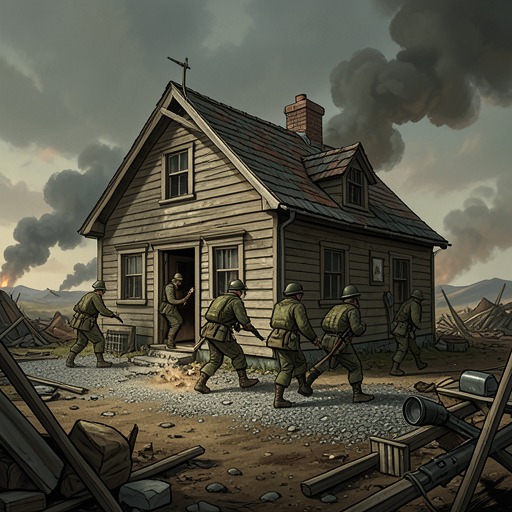
As the front nears, Laník and his sister move their belongings permanently into the basement. German forces dig trenches and build tank traps in the streets; tanks, half-tracks, and guns take over the tramlines and intersections. Rumours of Hitler’s death and the advance of the Allies circulate alongside the preparations for battle. Civilians shelter below ground, surfacing to search for necessities while the city’s public spaces are increasingly organized around warfare.
The House and the Uses of Shelter
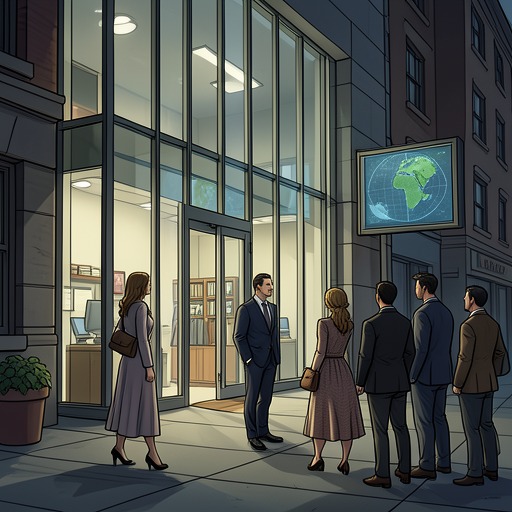
The Landauer House’s history makes the changing uses of space especially visible. Its construction had itself been delayed by problems with materials and workers, while its infant inhabitant grew through milestones such as her first smile and laugh. When the shell was finally complete, the building first appeared less like a home than a warehouse: bare concrete, rough dusty floors, white plaster, and single bulbs. Later, under Nazi occupation, the domestic rooms were repurposed for offices, laboratory work, photography, and anthropometric measurement. The onyx wall and the Glass Room became part of an apparatus of racial classification, while the Bösendorfer piano remained as an incongruous remnant of the house’s former life.
In a later period, the building served as a children’s physiotherapy gymnasium. Tomáš calls it the Glass Room, while the Czech word pokoj carries the additional senses of peace, quiet, and tranquillity. For him, the name evokes a refuge of light and stillness after work with children disabled by disease. A public discussion of the house identifies it as a modernist masterpiece in the Blackfield district, overlooking Lužánky Park and the city centre, yet debates its use as a gymnasium even while acknowledging the children’s need for care. This history contrasts the building’s architectural ideal with the changing human needs it must accommodate.
By 1990, the house has been repaired and partially restored: furniture has returned from the Moravian Museum, and plate glass has restored the Glass Room’s lucid openness. Its afterlife as an architectural destination follows the wartime and postwar uses that altered its function. Scarcity belongs to this larger history of material conditions shaping space: a home, a research centre, a treatment room, and finally a preserved monument are not separate from the crises and needs of the people who occupy them. The city’s wartime barter economy makes that dependence stark, measuring value not in money or design but in what can sustain life.